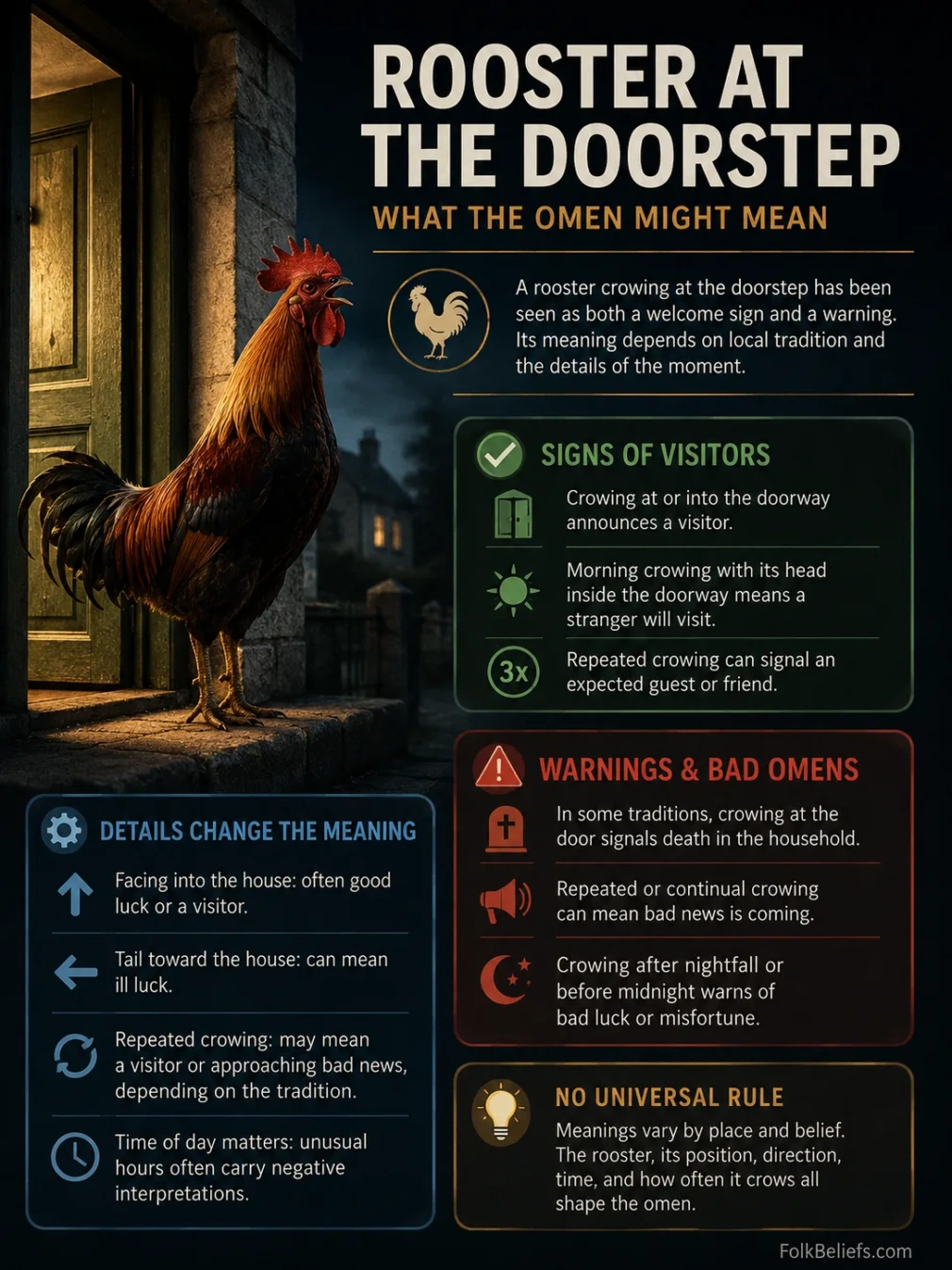
A rooster crowing at a doorstep does not carry one fixed meaning in recorded folklore. A tradition collected in Tiercahan, County Cavan, treated a rooster standing on the doorstep and crowing into the house as a sign that a visitor was coming.[1] A separate Irish record from Manorhamilton, County Leitrim, gave the same scene a much darker meaning and connected it with death in the household.[2]
The difference matters. In older rooster-at-the-door superstitions, where the bird stands, which way it faces, when it crows, and whether the crowing is repeated can change the interpretation.
A Rooster at the Door as a Sign of Visitors
The arrival of a visitor is one of the clearest recurring meanings attached to a rooster crowing at or near a household entrance.
James Napier recorded a West of Scotland belief in 1879 in which a cock crowing in the morning with its head inside the doorway meant that a stranger would visit the family that day. Napier described the belief as strong enough that a household might prepare for the expected guest. He also recalled being welcomed by a friend who said a visit had been anticipated because the cock had crowed three times with its head at the door.[3]
A similar belief appears in Elias Owen’s collection of North Welsh folklore. There, a cock repeatedly crowing on the door-sill was understood as announcing a visitor. The expected arrival was described as a friend rather than an unknown threat or source of misfortune.[4]
The idea also appears outside Britain and Ireland. In Roland Steiner’s 1899 collection of beliefs from central Georgia in the United States, a rooster crowing before a door was recorded simply as a sign of a visitor.[5]
The Tiercahan record adds an important detail: the rooster was not merely near the house. It stood on the doorstep and crowed into the house. In that local version, the action meant that a visitor was expected.[1]
When the Same Omen Meant Bad News or Death
Not every tradition welcomed a rooster at the entrance as advance notice of company. Some records attach an unfavorable meaning to almost the same behavior.
The bird-lore collected at Mastersons school in Manorhamilton states that a rooster standing at the door and crowing was considered a sign of a death in the house. The same record separately treats crowing after nightfall and before midnight as a warning of bad luck.[2]
Another Irish record, from Castlemacadam in County Wicklow, shows how the rooster’s orientation could reverse the omen. A cock coming to the door, facing toward the interior, and crowing was regarded there as good luck for the people inside. If the bird stood with its tail toward the interior while crowing, the record gave the action an ill-luck interpretation.[6]
At Terryglass in County Tipperary, repeated crowing carried another meaning. A Schools’ Collection entry says that continual crowing by a cock at the door signified that unpleasant news would soon be heard. The same record also associated crowing at unusual hours of the night with bad news.[7]
Details That Change the Meaning
Facing Into the House
Facing inward is not consistently lucky or unlucky across the surviving records. In Tiercahan it accompanies the visitor omen, while the Castlemacadam record connects a cock facing into the house with good luck. These are local interpretations rather than a universal rule.
Crowing Repeatedly
Repeated crowing can strengthen the idea that someone is coming, as in the North Welsh account and Napier’s Scottish example. In Terryglass, however, continual crowing at the door was linked with approaching bad news. The number or persistence of the crows therefore cannot be interpreted without knowing the tradition behind the belief.
Daytime and Nighttime Crowing
Several visitor traditions specifically place the event in the morning or daytime. Night crowing is more often separated from the ordinary visitor omen and given an unfavorable interpretation in the Irish records from Tiercahan and Manorhamilton.
Door, Door-Sill, and Doorstep
Historical sources use several closely related descriptions: a cock at the door, on the door-sill, standing on the doorstep, or putting its head into the doorway. These expressions describe a family of closely related entrance omens, but the exact position sometimes carries part of the meaning.
There Is No Single Doorstep Rooster Superstition
The surviving records do not support treating a rooster at the doorstep as automatically lucky, unlucky, or a prediction of one particular event. Visitors and arriving company appear repeatedly, including in records from Scotland, Wales, Ireland, and the United States. Yet Irish collections also preserve associations with death, bad news, good luck, and ill luck.
This variation is typical of orally transmitted folk belief. A recognizable scene can remain stable—a rooster approaches the domestic threshold and crows—while its interpretation changes between communities. Even neighboring traditions can attach different consequences to the direction the bird faces or the hour at which it crows.
These meanings are documented folk beliefs rather than evidence that rooster behavior predicts visitors, news, luck, or death. The value of the records lies in showing how different communities interpreted an ordinary farmyard event.
Sources and Records
- ↑1a ↑1b National Folklore Collection, UCD, “Birds,” Tiercahan,
- ↑2a ↑2b National Folklore Collection, UCD, “Bird-Lore,” Mastersons,
- ↑3 James Napier, Folk Lore; or, Superstitious Beliefs in the West of Scotland Within This Century,
- ↑4 Elias Owen, Welsh Folk-Lore: A Collection of the Folk-Tales and Legends of North Wales,
- ↑5 Roland Steiner, “Superstitions and Beliefs from Central Georgia”,
- ↑6 National Folklore Collection, UCD, “Animal-Lore,” Castlemacadam,
- ↑7 National Folklore Collection, UCD, “Traces and Survivals of Pagan Religious Customs — Beliefs in Omens and Accidents,” Terryglass,
Documented Locations
Countries: Canada
These labels identify where a version has been documented. They do not mean that everyone in the country, region, or community shares the belief.