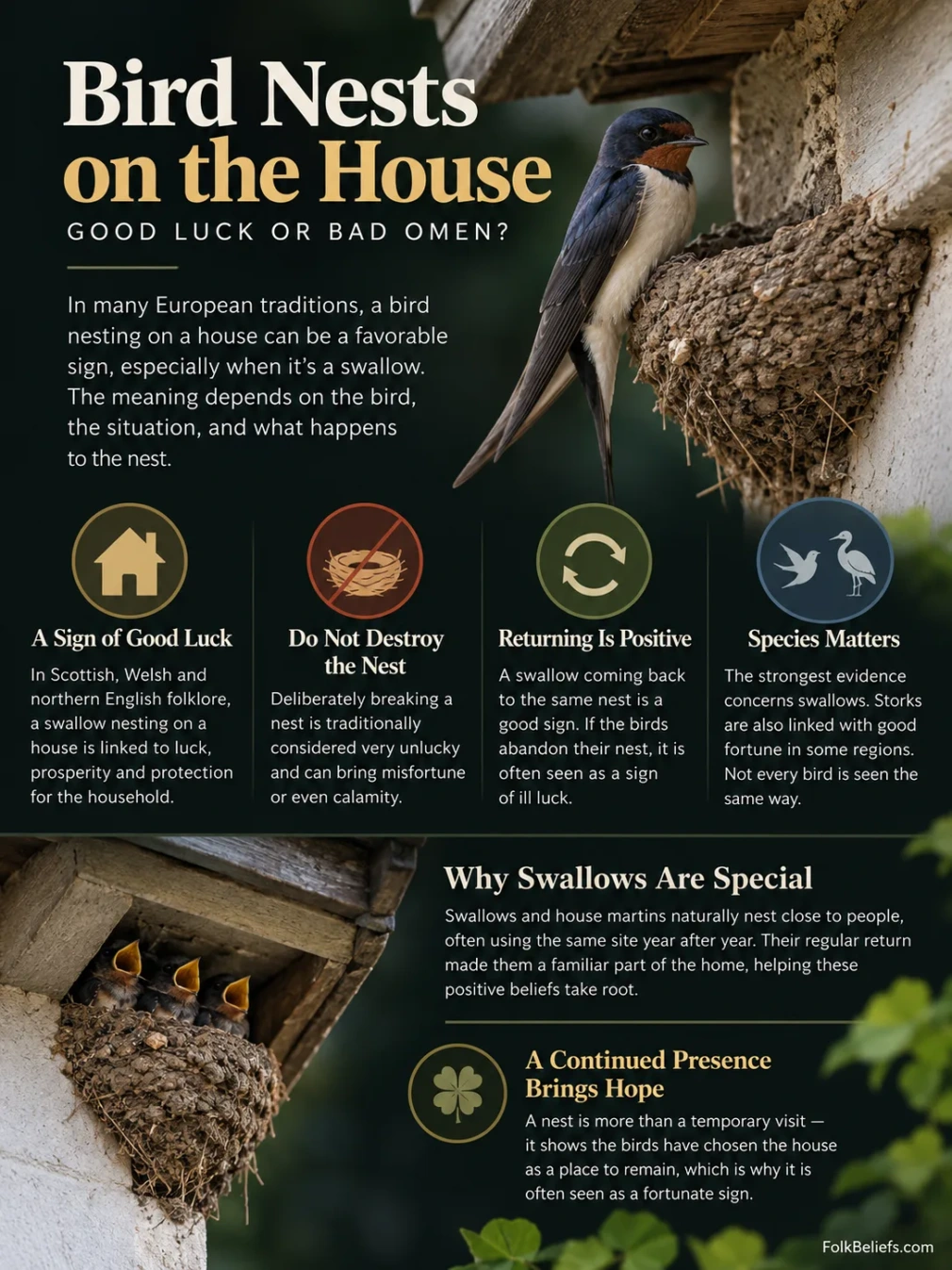
In several documented European traditions, a bird nesting on a house could be read as a favorable omen, but the meaning was not attached to every bird in the same way. The clearest records concern swallows and other house-nesting hirundines. In a nineteenth-century collection from the West of Scotland, a swallow building in a window corner was regarded as lucky and associated with prosperity for the household. Deliberately tearing down the nest, by contrast, was feared as an act that could bring severe misfortune.[1]
Recorded Meanings of Birds Nesting on Houses
Historical records do not support one universal rule such as “any bird nest means good luck.” The bird, place, and what happened to the nest could all change the interpretation.
| Place and Record | Bird | Recorded Belief |
|---|---|---|
| West of Scotland, recorded in 1879 | Swallow | A nest in a window corner was treated as a lucky omen associated with prosperity. Destroying it was feared as an invitation to calamity.[1] |
| Wales, recorded in the nineteenth century | Swallow | The birds visiting and nesting along a house were considered a sign of luck. If a swallow forsook its old nest on the house, the change was interpreted as ill luck. Breaking the nest was also considered unfortunate.[2] |
| Northern England and the Borders | Swallow | Swallows taking possession of a place and nesting around it were described as a good omen, while abandoning a previously occupied place was unfavorable. Henderson also recorded related traditions in which the bird was associated with protecting the dwelling from fire, storms, or other harm.[3] |
| Moldavia and Bucovina folklore material in Romania | Swallows and storks | Archived and field material examined in a 2019 study connects birds nesting at the home with good fortune. Harming or disturbing these house-associated birds could carry the opposite meaning, including traditions linking destroyed nests with fire or misfortune.[4] |
Why the Swallow Appears So Often in House-Nest Folklore
The repeated appearance of swallows in these beliefs fits their actual nesting behavior. Some birds in the swallow family live unusually close to people. The Common House Martin (Delichon urbicum), for example, commonly builds mud nests beneath the eaves of homes and other buildings. Old nests may also be used again in later breeding seasons.[5]
This made the arrival of the birds easy to notice. A family might see them return to the same wall or eave each spring, repair a nest, raise chicks, disappear during migration, and return again. That recurring relationship between bird and dwelling gave people a natural setting in which household beliefs could develop.
The result is a pattern in which the nest represents more than a temporary visit. In the recorded traditions above, the bird has chosen the property as a place to remain and breed. That continuing presence is what tends to carry the favorable meaning.
When a New Nest Is Considered Lucky
In the Scottish, Welsh, and northern English material, a swallow beginning to nest at a dwelling is generally on the favorable side of the omen. The meanings include luck, prosperity, and protection of the household.
It is more accurate to describe these as local recorded meanings than to say that a bird building a nest always predicts good fortune. Even closely related traditions can differ in their details.
The species also matters. The strongest evidence in these records concerns swallows. A pigeon, sparrow, wren, robin, or another bird making a nest on a building should not automatically be assigned the same traditional meaning simply because it is also a bird.
Returning to the Same Nest Has a Different Meaning From Leaving It
Several traditions pay attention not merely to the existence of a nest, but to whether the birds continue using the site.
The Welsh record is especially clear. A swallow returning to the house was welcomed as lucky, while forsaking an established nest was considered an unfavorable change. Henderson’s northern English collection records a similar contrast between taking possession of a place and later abandoning it.
This creates a recognizable folklore pattern: continued nesting represents continuity at the home, while unexpected departure reverses the favorable omen. That is a traditional interpretation rather than a prediction of what will actually happen to the people living there.
Birds can change nesting sites for ordinary natural reasons. An unused nest therefore does not provide evidence that misfortune is approaching.
Destroying the Nest Is the Strongest Taboo
The darker side of this folklore usually concerns human interference rather than the arrival of the birds themselves.
Napier’s West of Scotland record says that removing a swallow nest was treated as tempting fate. The Welsh material likewise presents breaking the nest as deeply unlucky, while traditions collected farther south and east also attach penalties to harming house-nesting swallows.
The exact threatened consequence varies. Some accounts speak broadly of misfortune. Others name loss, fire, or calamity. These variations should remain separate because they come from different places and collections rather than from a single shared rule.
Whatever explanation people gave for the taboo, it had a simple practical effect: a bird that nested close to the household could be left in peace because harming its nest was feared.
A Bird Nesting at the House Is Not the Same Omen as a Bird Flying Inside
These two beliefs are often mixed together, but historical collections can treat them very differently.
Napier’s West of Scotland material is a useful example. The swallow nesting in a window corner was favorable, yet the same collection records a separate belief that a bird entering a house and flying over someone’s head was unlucky for that person.[1]
The difference shows why the action matters. A bird choosing the building as a nesting place and a bird unexpectedly entering an interior room belong to different omen traditions. The meaning of one should not be transferred automatically to the other.
Does the Location of the Nest Change the Meaning?
A nest beneath the roof, under an eave, beside a window, or on another sheltered part of the building may feel symbolically different today, but the historical evidence does not provide a separate omen for every modern location.
The window corner does appear specifically in the Scottish record. Eaves and exterior walls also have an obvious connection with swallows and house martins because those are normal nesting sites for the birds.
There is much less basis for rigid claims such as:
- a nest above the front door always predicts visitors;
- a nest outside a bedroom predicts pregnancy;
- a nest on the left or right side of a house has a fixed meaning;
- a nest on a balcony guarantees money or marriage.
Such interpretations should not be presented as old universal rules without a record that actually documents them.
Does a Bird Nest Mean a Baby, Pregnancy, or New Beginning?
Not as a general bird-nest superstition. The historical swallow records used here focus much more clearly on household luck, prosperity, protection, continued good fortune, and the danger of disturbing the nest.
Ideas about nests representing family life or new beginnings are understandable symbolic readings because nests contain eggs and young birds. They are not, however, the same thing as a documented tradition saying that a nest on someone’s house predicts pregnancy.
Storks have their own separate associations with family and childbirth in European folklore, but that tradition should not be expanded into a rule that every species nesting on a roof announces a baby.
What If the Bird Abandons the Nest?
In Welsh and northern English swallow lore, abandonment can reverse the favorable meaning of an occupied nest. This is one of the more clearly documented variations of the belief.
It is still folklore rather than a warning that something will happen to the household. A bird leaving a nesting site is an animal behavior, not a reliable forecast of illness, loss, or another future event.
The same distinction applies when an old nest remains empty after migration. Traditional stories may attach meaning to the absence, while the physical nest itself only shows that birds used the site at some point.
Folklore meaning and natural behavior are separate. A bird nesting on a house can be culturally meaningful to someone familiar with these traditions, but the nest does not provide evidence of supernatural protection or future misfortune. The documented beliefs are most useful when kept connected to the particular bird, locality, and historical record in which they were collected.
Sources and Records
- ↑1a ↑1b ↑1c James Napier, Folk Lore; or, Superstitious Beliefs in the West of Scotland Within This Century,
- ↑2 Elias Owen, Welsh Folk-Lore: A Collection of the Folk-Tales and Legends of North Wales,
- ↑3 William Henderson, Notes on the Folk-Lore of the Northern Counties of England and the Borders, Chapter IV,
- ↑4 Adina Hulubaş, “Protectori zoomorfi ai casei. O perspectivă deschisă de documente inedite aflate în Arhiva de Folclor a Moldovei și Bucovinei”,
- ↑5 British Trust for Ornithology, “House Martin”,
Documented Locations
Countries: China, Cyprus, France, Germany, Japan, Lithuania, Morocco, Spain, United Kingdom, Uzbekistan
These labels identify where a version has been documented. They do not mean that everyone in the country, region, or community shares the belief.