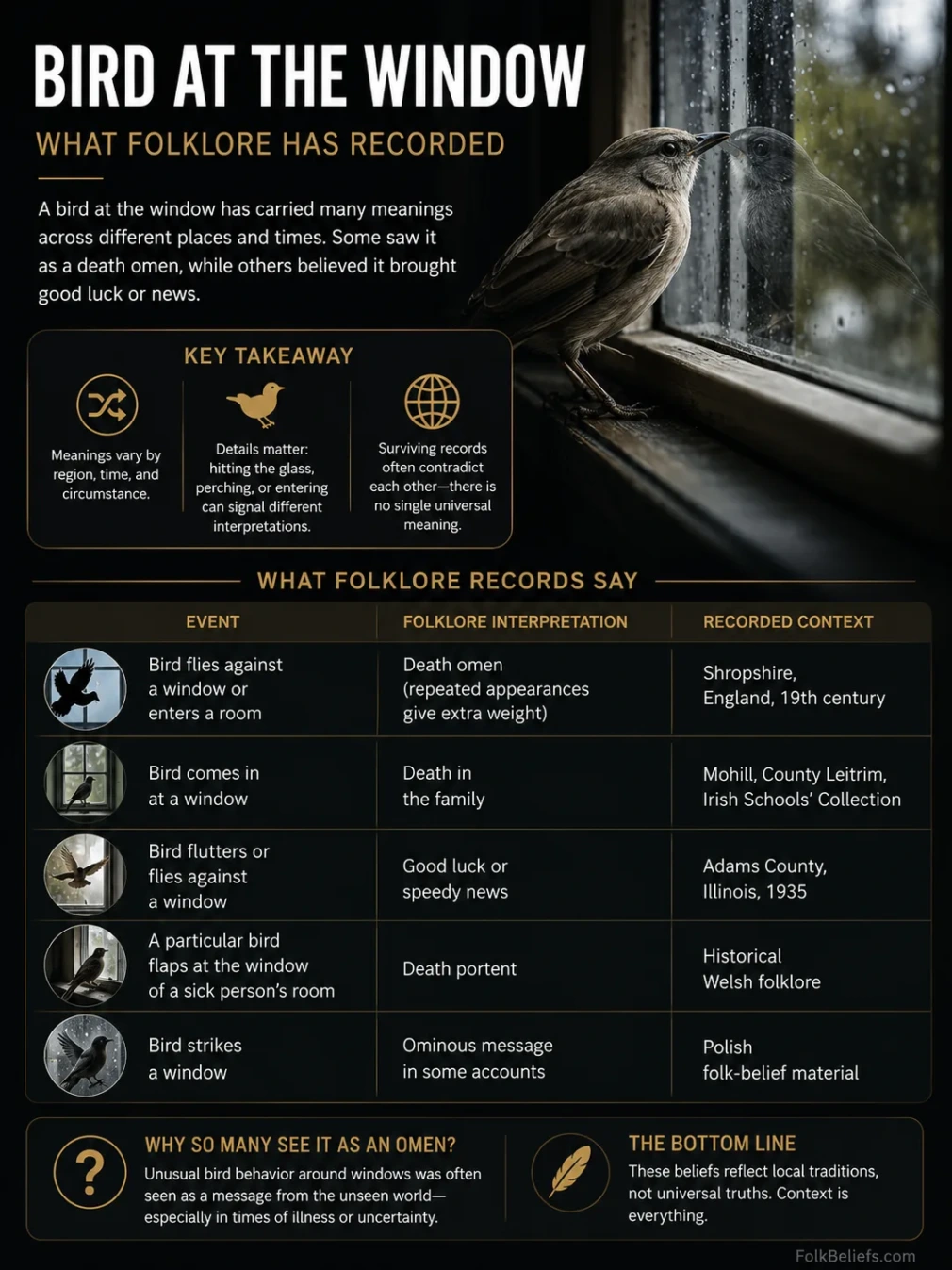
A bird appearing at a window does not have one fixed meaning in recorded folklore. Older British material treats birds hovering around a house or tapping a window-pane as death omens, while an American archive record connects a bird lingering on a windowsill or porch with hearing of a death.[1][2]
The exact behavior matters. A bird resting on a sill, hovering near a house, or deliberately pecking at a pane belongs to a different situation from an accidental high-speed collision with glass. Historical collections also attach different meanings to these window visits, so the event cannot be reduced to one universal omen.
What a Bird at the Window Meant in Recorded Folklore
| Recorded Event | Folklore Interpretation | Recorded Context |
|---|---|---|
| Birds hover around a house or tap against a window-pane | Omen of death | British domestic folklore recorded by T. F. Thiselton-Dyer[1] |
| A bird seeks shelter around a house, including on a windowsill or porch, and remains there | Someone known to the observer will die | James T. Callow Folklore Archive record, learned in 1967[2] |
| A pigeon alights on a window-sill | Sign of a death | Carlingford, County Louth, Irish Schools’ Collection[3] |
| A bird picks at the window | Sign of hard weather | Cluain Eich, County Leitrim, Irish Schools’ Collection[4] |
| A particular bird flutters at the window of a sick person’s room | Death portent | Welsh corpse-bird tradition recorded by Elias Owen[5] |
These records show why the phrase bird at the window needs context. Some accounts concern a bird simply remaining near the house. Others describe tapping or fluttering. One Irish record gives a weather meaning rather than a death omen. Each entry belongs to its own collected setting.
Why the Exact Window Behavior Matters
A bird sitting quietly on a windowsill was enough to carry an omen in some traditions. The Carlingford record is especially narrow: it names a pigeon alighting on the sill and associates that event with death. The Callow archive preserves another version in which the bird stays around the house, with a windowsill or porch given as examples of places where it might seek shelter.
Tapping or pecking could receive another interpretation. Thiselton-Dyer grouped birds tapping the window-pane with birds hovering around a house as death-related signs, but the Schools’ Collection record from County Leitrim gives a bird picking at the window a weather meaning instead.
The action should therefore not be separated from the record that describes it. A belief about a pigeon resting on a sill does not automatically establish the same meaning for every bird that approaches a window.
The Welsh Corpse-Bird Tradition
Elias Owen’s nineteenth-century Welsh Folk-Lore records a more specific window belief called the Deryn Corph, or corpse bird. In Owen’s account, the bird came to the window of a room where a sick person lay, fluttered there, and made a screeching sound. The visit was interpreted as a portent of that person’s death. Owen associated the bird with the tawny or screech owl in the tradition he recorded.[5]
This belief has several details that matter: the person inside was ill, the bird behaved unusually at that room’s window, and a particular bird tradition was involved. It does not support the broader claim that any bird seen through a window predicts a death.
Does a Bird at the Window Mean Someone Will Die?
No reliable prediction follows from a bird appearing at a window. Death is well represented in historical window folklore, but the records document beliefs rather than proof that the event predicts what happens afterward.
The surviving material is also more varied than the familiar death-omen version suggests. A pigeon on a sill, a bird lingering near a house, repeated tapping, and a bird connected with weather lore appear as separate recorded forms. Their meanings should not be merged into a single rule.
A Window Visit Is Not the Same as a Window Collision
A bird perching beside the glass or repeatedly pecking at a reflection is behaviorally different from a bird flying into glass during normal flight. Folklore sources sometimes place many bird-and-window events near one another, but that does not make them identical beliefs.
For a general bird-at-the-window belief, the most relevant details are the bird’s presence, perching, hovering, tapping, or repeated attention to the pane. An accidental impact with the glass is a separate event and should be treated on its own terms.
Why a Bird May Keep Pecking at the Same Window
Repeated pecking often has an ordinary behavioral explanation. During territorial periods, a bird may see its reflection in a window and react as though another bird has entered its territory. Audubon notes that this behavior is common during the breeding season and is well known in birds such as Northern Cardinals and American Robins.[6]
The bird may return to the same pane many times because the reflected rival appears whenever the lighting and viewing angle are right. From inside the house, the repeated movement can resemble deliberate knocking.
That explanation does not erase the historical folklore attached to tapping birds. It simply separates the physical behavior of the bird from the meaning that a particular community or informant once assigned to it.
Sources and Records
- ↑1a ↑1b T. F. Thiselton-Dyer, Domestic Folk-lore,
- ↑2a ↑2b University of Detroit Mercy Libraries, James T. Callow Folklore Archive, “Superstition”,
- ↑3 National Folklore Collection, “Bird-Lore,” Carlingford (B.), County Louth,
- ↑4 National Folklore Collection, “Signs,” Cluain Eich, County Leitrim,
- ↑5a ↑5b Elias Owen, Welsh Folk-Lore: A Collection of the Folk-Tales and Legends of North Wales,
- ↑6 Andy McGlashen, “Why Birds Attack Windows and Mirrors—and How You Can Stop Them”,
Documented Locations
Countries: Argentina, Brazil, Estonia, Pakistan, Peru, Poland, Russia, United Kingdom, United States
These labels identify where a version has been documented. They do not mean that everyone in the country, region, or community shares the belief.