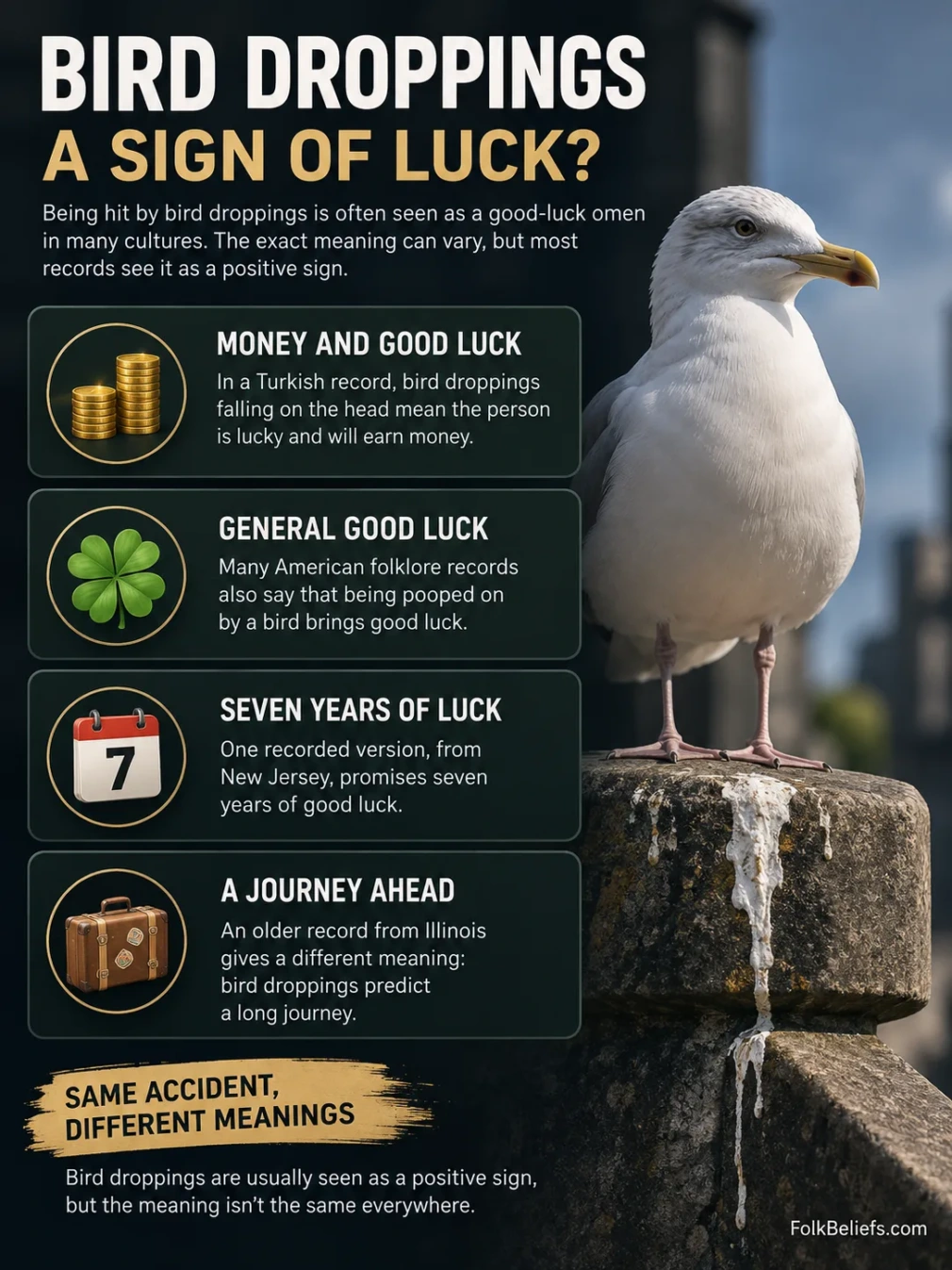
Being hit by bird droppings is often treated as a good-luck omen, but the recorded meanings are not identical everywhere. A Turkish government collection gives a particularly clear version: when bird excrement falls on a person’s head, the person is considered lucky and is expected to earn money.[1] American folklore archives also preserve versions promising good luck, while an older Illinois collection assigns a different outcome—a future journey rather than general good fortune.
What Bird Droppings Are Said to Mean
The basic idea is simple: an unpleasant accident is interpreted as a favorable sign. The details depend on the individual record, family, and place where the belief was collected.
| Recorded Context | Folklore Meaning |
|---|---|
| Turkish superstition collection | Droppings falling on the head mean the person is lucky and will earn money.[1] |
| New Jersey, United States, 2012 record | Being pooped on by a bird gives the person good luck.[2] |
| Virginia, United States, 2020 collection | Good luck is expected to follow after a bird poops on someone.[3] |
| New Jersey, United States, 2011 record | One family-connected version promises seven years of good luck.[4] |
| Adams County, Illinois, 1935 collection | Droppings falling on a person while a bird flies overhead predict a long journey.[5] |
Bird Droppings and Money Luck
The connection with money is directly documented in the Turkish record. The Ministry of Culture and Tourism’s collection does not merely describe the event as vaguely fortunate: its wording connects bird excrement falling on the head with being lucky and earning money.[1]
This evidence supports describing money as one recorded interpretation of the superstition. It does not establish a rule that every community associates bird droppings with wealth, nor does it show that every part of Türkiye has used the belief in exactly the same way.
Does Bird Poop Mean Seven Years of Good Luck?
Seven years of good luck is a documented version, but not a universal rule. A 2011 USC Digital Folklore Archives record from New Jersey preserves a saying that contrasts breaking a mirror and receiving seven years of bad luck with being pooped on by a bird and receiving seven years of good luck.[4]
Other collected versions simply promise good luck without giving it a duration. The seven-year detail should therefore be treated as a particular variant rather than a fixed part of the superstition.
A Belief That Can Turn an Unpleasant Accident Into Luck
Several American archive records preserve an interesting social setting for the belief. In a 2012 USC record, an informant remembered being told that bird droppings meant good luck after a seagull pooped on him; he later thought his parents may have said it to make him feel better.[2]
A Dartmouth Folklore Archive entry collected in 2020 records the belief from a child in Virginia who had heard it from his father. The collector also remembered hearing the same superstition after personally being pooped on and described it as cheering up an otherwise unpleasant moment.[3]
These records show one way the superstition circulates: it can be passed through families at the exact moment the accident happens. That context helps explain why the saying may function both as a genuine luck belief and as a humorous reassurance.
Not Every Bird-Dropping Omen Predicts Good Luck
An older American record shows why the belief should not be described as having one meaning everywhere. Harry Middleton Hyatt’s Folk-lore from Adams County, Illinois, published in 1935, includes an entry stating that if a bird flying overhead lets droppings fall on a person, that person will take a long journey. The accompanying account connects such an incident with a later trip south.[5]
This Illinois version is useful because it preserves a different interpretation of the same physical event. Bird droppings can belong to a broader family of personal omens without always meaning money or good luck.
Does It Matter Where the Droppings Land?
The surviving records do not support a universal body-location system. The Turkish collection specifically mentions droppings falling on the head, while the American good-luck records generally describe a bird pooping on a person. The evidence reviewed here does not establish dependable separate meanings for the right shoulder, left shoulder, hand, clothing, or other body parts.
The same caution applies to bird species. One USC account happened after a seagull was involved, but the belief recorded there concerns bird droppings generally rather than a special seagull omen.[2] Claims that pigeons, crows, gulls, or other birds each produce a fixed type of luck require their own supporting folklore records.
Is Being Pooped on by a Bird Really Lucky?
Folklore archives can show that people have said, repeated, remembered, and sometimes believed that bird droppings bring luck. They do not demonstrate that the accident changes a person’s future.
The records also show why a single origin story is difficult to defend. The documented versions differ in outcome and detail: money in one Turkish collection, unspecified good luck in several American accounts, seven years of luck in another family-connected version, and a journey in the 1935 Illinois material. The safest reading is therefore that bird-dropping omens exist in multiple forms rather than as one fixed worldwide superstition.
Folklore note: These meanings describe recorded beliefs and sayings. They should not be treated as certain predictions of money, travel, or future events.
Health and hygiene note (2026): Folklore may treat bird droppings as lucky, but they are still biological waste and should be handled hygienically. CDC reported in March 2026 that A(H5) bird flu remains widespread in wild birds while the current public health risk is low.[6] Infected birds can shed avian influenza viruses in their feces, so direct contact with sick or dead wild birds and potentially contaminated material should be avoided; USDA continues to monitor HPAI detections in wild birds.[7][8]
Sources and Records
- ↑1a ↑1b ↑1c Republic of Türkiye Ministry of Culture and Tourism, “Superstitions”,
- ↑2a ↑2b ↑2c USC Digital Folklore Archives, “Bird poop = good luck”,
- ↑3a ↑3b Dartmouth Folklore Archive, “Bird pooping on you for good luck”,
- ↑4a ↑4b USC Digital Folklore Archives, “Bird Poop”,
- ↑5a ↑5b Harry Middleton Hyatt, Folk-lore from Adams County, Illinois,
- ↑6a CDC, “A(H5) Bird Flu: Current Situation”,
- ↑7a CDC, “Preventing Bird Flu Infections”,
- ↑8a USDA APHIS, “Detections of Highly Pathogenic Avian Influenza in Wild Birds”,
Documented Locations
Countries: Argentina, Venezuela
These labels identify where a version has been documented. They do not mean that everyone in the country, region, or community shares the belief.