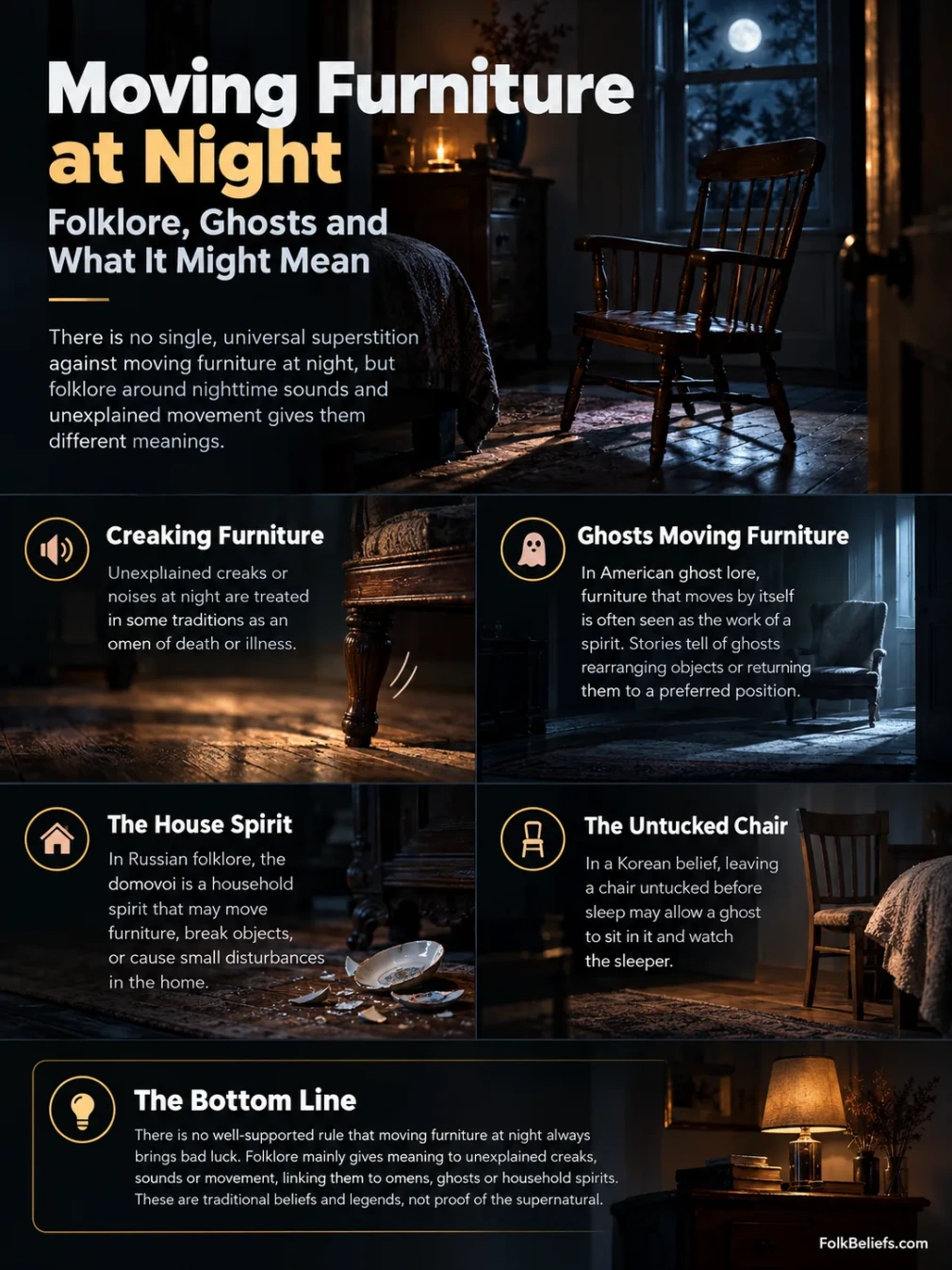
The phrase “moving furniture at night” does not describe one universal superstition. In better-documented folklore, the uneasy part is usually furniture that creaks, shifts, or seems to move when no ordinary mover is present. Older omen collections, ghost legends, and house-spirit traditions give those events different meanings.
A broad rule saying that people everywhere—or all people in one country—must never rearrange furniture after dark is not well supported by the records below. The evidence is narrower: particular collections and informants connect nighttime furniture sounds or unexplained movement with omens, ghosts, or household spirits.
What Is Actually Recorded?
| Recorded Belief or Motif | Folklore Meaning | Recorded Context |
|---|---|---|
| Furniture creaks at night without an obvious cause | Treated as an omen of death or illness | Astra Cielo’s 1918 English-language superstition collection lists this under “Portents of Evil.”[1] |
| Furniture seems to move when nobody is there | Interpreted as ghost activity in legend | Folklorist Libby Tucker documents furniture-moving ghost traditions in New York homes and college settings.[2] |
| A household spirit moves furniture or breaks objects | Mischief, warning, or disturbance within the home | A USC folklore record from a Russian-Armenian informant describes the domovoi as a house spirit that may move furniture and break plates.[3] |
| A chair is left untucked before sleep | A ghost may sit in it and watch the sleeper | A USC archive entry records this as one of several childhood nighttime ghost taboos reported by a Korean informant.[4] |
Why Night Changes the Meaning
Night matters in many household beliefs because ordinary domestic space feels different after activity stops. A scrape, knock, or creak can be heard more clearly, while the cause may be harder to see. Folklore can turn that uncertainty into a story about an omen, a ghost, or a resident spirit.
That does not make “night” a single rule across cultures. The Korean chair taboo, for example, concerns the position of a chair before sleep, not a ban on rearranging a room. It belongs to a small set of ghost warnings collected from one informant and should be read at that scale.
Furniture Moving by Itself in Ghost Lore
Unexplained furniture movement has a clear place in American ghost legend. Tucker notes a New York tradition of ghostly furniture movers and discusses a story collected in 1914 about Aunt Sylvina, a dead family member said to return furniture to her preferred arrangement after younger relatives changed it. The same article also records a college legend in which a student hears furniture scraping in an apparently empty room above her.[2]
These stories are legend material, not proof of supernatural movement. Their interest lies in what the sound means inside the story: a presence is imagined through an object that appears to move without a visible person pushing it.
The Domovoi Connection in Russian Folklore
Russian house-spirit lore offers another explanation for displaced household objects. In one USC archival record, the domovoi is described as a spirit of the home, family fortune, and mischief that may move furniture or break plates. The record comes from a particular performance context rather than a claim about every Russian household.[3]
This distinction matters. A spirit being said to move furniture is not the same belief as a rule forbidding people from moving furniture after sunset. The USC record supports the first motif; it does not establish a general Russian prohibition on rearranging furniture at night.
So Is It Bad Luck to Rearrange Furniture at Night?
There is no well-supported universal answer. A family or local tradition may treat late-night rearranging as unlucky, but the documented material tied closely to this topic points in several directions: nighttime creaking may be read as an omen, unexplained movement may be attributed to ghosts, and house-spirit lore may explain why objects seem to change place.
- If a person deliberately moves a chair, table, or sofa at night: the records here do not establish a universal bad-luck rule.
- If furniture seems to move by itself: ghost and house-spirit traditions provide folklore explanations for the event.
- If furniture creaks at night: at least one early twentieth-century superstition collection treats unexplained creaking as an ominous sign.
These are records of folk belief and legend. They do not show that furniture movement, creaking, or room arrangement can predict illness, death, luck, or the presence of spirits.